
Writing a book? Don’t publish your first draft!
13 November 2026
I bought a book recently. It had been vanity published for a hefty fee (I know this because I know of the publisher), with a badly-designed front cover and a back description best described as “befuddling”.
You might reasonably ask, “why did you buy this book, then?” And I would tell you – in a slightly embarrassed tone – that I bought it because its author was standing in front of me. We were chatting about their career as an author, right next to a brazen pile of their assorted literary bursts. “That one’s my personal favourite,” they said, indicating the book I would go on to buy. “I really enjoyed writing it, and it’s got some great feedback.”
What else was I supposed to do, after that? Back slowly away, muttering something like, “wow, that’s great for you, I hope you sell millions of copies”?
(Probably).
This author may have enjoyed writing their personal favourite book, but reading it felt like a strange assault.
It was objectively terrible. No real structure, characters without descriptions, relationships with no context, events that happened out of nowhere. It was also riddled with spelling mistakes. It made me cry with laughter, but for all the worst reasons.
The author was right, though. This book did have great feedback… at least from the handful of reviewers who’d each awarded it five stars on Amazon. Browsing their sugared words, I wondered if they’d been reading the same book as I just had. Might they be related or known to the author in some way?
Who knows.
(Here’s a piece of advice: never buy a book that has all five-star reviews. It’s almost certainly tosh).
I did know this: there had been zero editing. No lines crossed out in bright red pen; no determined moments of “let’s look at this bit again”. It read like the author had scribbled their first draft, then sat back and revelled in the warm glow of Writing a Book.
But the thing is, they hadn’t Written a Book at all. They’d just finished their first draft.
The first draft is still a hefty milestone, worth celebrating. Finally, the story is out of your head and down, roughly, on the page. But there will – there should be! – plenty more drafts, before you ask anyone to fork over their hard-earned cash for your book.
There’s a reason why Hemingway said, “the first draft of anything is shit.” It’s because the first draft of anything is shit. He also went on to say, “When you first start to write you get all the kick and the reader gets none…” which is a line that has stayed with me. If you write, it should stay with you as well.
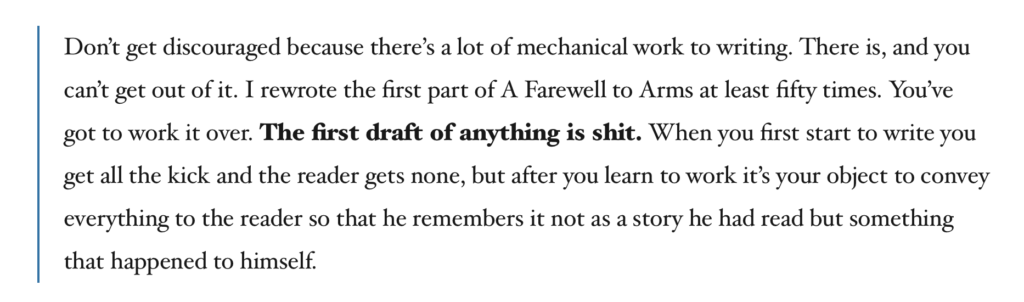
Image taken from quoteinvestigator.com
Where do you go from that shit first draft, then?
Don’t look at your book for at least a month. You’ll return to it with fresher eyes, which means you’ll spot problem areas more easily: scenes that stall the story, passages that don’t work, sentences that ramble on (and on).
You’ll also need to take a deep breath, steel yourself, then ask a small handful of people for feedback. These must be people you trust, and they have to be honest. Seriously… some of their comments should make you wince.
No first draft is perfect, so if all you hear is that everyone loved everything, something is wrong. Ask again, but this time go deeper. Be more specific. Say, “I’d really like to know what didn’t work for you,” or “What was your least favourite bit?”.
This is hard. I’ve got first-hand experience of it being hard (like drink a whole bottle of wine in one sitting hard), but your book won’t improve if those first readers aren’t honest.
And you want it to improve… don’t you?
If you’re not sure; if all you really want is a book with your name on the cover and a few insincere reviews, you may need to be brutally honest with yourself.
I had a call recently with a potential client. They’d written the first draft of a book, but the process had been emotionally exhausting, so they didn’t want to edit or rewrite it. Just “get it out there, as quickly as possible.”
To say I know this feeling is an understatement. I’ve been editing my first novel, Something Else, for over a year.
It’s been through countless rounds of feedback. I’ve dumped more than double the amount of words I’ve kept. Truth be told, I am sick to death of my book. I persevere, though, because I’ll be asking people to spend their money and their time on reading it. If they don’t like Something Else, it won’t be because I didn’t put everything I have into making that book as good as I could possibly make it. That feels very important.
Hemingway finished his advice with, “…after you learn to work it’s your object to convey everything to the reader so that he remembers it not as a story he had read but something that happened to himself.” If you ask me, that’s a goal every book should aspire to.
As we neared the end of our call, that potential client asked if I could edit their book for them. I said I could, but it would cost more than if I just gave them some pointers to work on themselves.
“I haven’t got the time or money for all that!” they muttered impatiently, brow deeply furrowed. “I’ll just go ahead and publish it now, by myself.”
I wished them all the best.
My mentoring sessions are for writers who don’t just want to say, “I wrote a book.” They’re prepared to put their whole hearts into creating books readers can cherish. If you like – and slightly fear! – the sound of that, let’s talk.