
Do you HAVE to “email your list every day”?
26 July 2023
Will an email a day keep the bailiffs away?
Business advice is plentiful, contradictory, and often overwhelming, especially when it’s about “being present” online. “Post something every day!” cry the marketing gurus. “Email your list EVERY WAKING MOMENT OF THEIR SORRY LITTLE LIVES!”
OK, that last quote is an exaggeration. But only slightly.
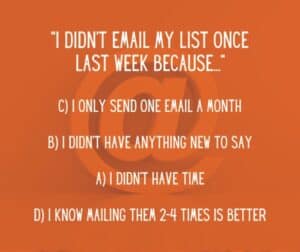
Image taken from a recent LinkedIn post.
According to the accompanying post – written by an email copywriter – “stats” show that 9-16 emails per month, or 2-4 per week, is the “ROI sweet spot” (ROI means “return on investment”, for those who don’t reside in Business Jargon Land). No source was listed for these stats, so I did my own research and found… lots and lots of differing stats and advice.
To summarise, email marketing experts want to turn us all into dedicated inbox-botherers, with the ‘ideal’ message-frequency ranging from once a fortnight to every single day.
Do daily emails work? Ask the audience.
The reason “be present online”-related advice differs so much is because there isn’t one definitive answer. That’s because no two people are the same. You might not mind getting a daily email from a company you follow, but I’ll unsubscribe after the second or third message. Maybe sooner. Life’s too short.
If you’re not sure, ask the people you currently email – or if you’re building a new list, seek opinions from the type of people you most want to sign up to it. You could even segment your list so that those who want to hear more from you, do.
You might also want to think about the most important question of all.
Have you got something new, interesting, or useful to say?
You’ll get away with sending a daily email if readers are rewarded with new, interesting, or genuinely useful information every time. It’s why the most popular emails are not sent by ‘creators’ or ‘gurus’, but news organisations.
(The Morning, a daily news briefing from The New York Times, is considered to be one of the world’s most-read email newsletters).
If you struggle for new and exciting things to say every day – I know I do! – it could be better to run a less-frequent schedule. A weekly, fortnightly, or monthly email will give you a certain amount of time to make some good, regular notes on insights, issues, and information that are worth sharing.
The result? People will feel more inclined to open and read your emails, and you’ll stress less over writing them.
Get your followers into a routine
However often you decide to send and post, sticking to the same days and times means readers will start expecting to hear from you. Some might even look forward to it!
I compare this to having a favourite columnist in a magazine: if you know there’ll be a new piece from them every Friday, you’ll make a point of looking out for it. But if you never know when they’ll be writing something new, other pieces will take priority. You might start to forget why you liked that columnist in the first place.
So prioritise consistency over frequency, as you also try to remember…
…it’s not really about you, is it?
A LOT of email marketing advice is worryingly geared towards the sender, not the reader. How many times are we told that if we want to double or triple our income, all we have to do is build and monetise an email list?
That isn’t even half as easy as it sounds, but it’s totally fine all the same. We can all recognise a marketing email when we read one. It’s not as if they’re rare. Our inboxes strain at the seams with companies trying to sell us things. We know the deal.
So keep your readers front-and-centre as you craft your emails. That means not writing only to sell, or to “position yourself as an expert”, but to connect, delight, inspire, and enthral.
In short: if you want people to buy from you, meet them half-way. Help them get to know you, and make your messages worth their precious time, every time.
I send a monthly newsletter, which I do use to sell things (full disclaimer)… but not in a horrible all-up-in-your-face sort of way. It’s also got some advice about writing and connecting, if you like that sort of thing. If you do, you can sign up here.
And if you’d quite like me to take email newsletter-writing off your to-do list altogether, let’s have a chat.