
Give your brain a chance: on rejecting AI
21 November 2025
I’ve been thinking – a lot – about the AI-related conversation I had with a prospective client last week. (Here’s the lowdown on that). What struck me most was the blatant request for me to swap writing for AI-prompting. I’ve been ditched for an AI chatbot before, but I’ve never been asked to ditch myself for an AI chatbot. It wasn’t a nice feeling.
But.
People who haven’t got time to write also won’t have time to create detailed AI writing prompts. Reasonably, many will think prompting AI is cheaper, more efficient, and better than asking a human to do the writing. (It isn’t, but I can – begrudgingly – understand why some people think it is).
This means I shouldn’t be surprised when people ask me to prompt AI for their writing.
However, I will always say no when they do.
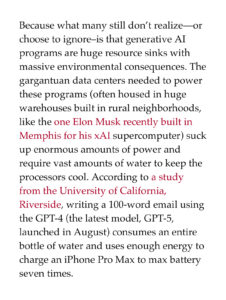
The above excerpt is from this fabulously biting article in Jezebel
“Enhance, don’t replace”
That’s my ‘attitude to AI’ motto, that is.
Don’t get me wrong, I hate AI. It’s the Frankenstein’s Monster of creativity: myriad human efforts stitched together to resemble something human-like. Using it harms both the environment and our vital human capacities for creativity and independent thought. I think companies who ditch people for AI are in for a rude awakening once they’re dependent. What happens if the tech-bro-overlords suddenly decide to ramp up their prices and/or introduce hellish terms and conditions to keep using their systems?
(Also – who honestly wants to outsource their thinking to systems dreamed up by those very same tech-bro-overlords?)

From the marvellous article, Using Grok is like believing what your farting uncle says at Christmas, by the even more marvellous Stewart Lee.
But.
I’m a bit of a hypocrite, because I do use AI to take notes for me in long, chatty meetings. That way, I can focus on listening, knowing the nitty-gritty is on file. This is what I mean by “enhance, don’t replace”, because if I’m a better listener, I’ll be a better writer – which my AI note-taker helps me achieve. AI doesn’t, and will never, do my writing for me.
The one good thing about our collective embrace of AI is how it’s made me rethink other, previously outsourced, areas of my life.
Recently, I wrote about ditching my calculator for a week. I did this because I’m always moaning about people using AI to write for them… but as a writer, I’m aware that I don’t need that kind of help.
I’ve always struggled with mental arithmetic, though. My thinking was that doing maths in my head for a while would help me empathise with people who use AI for writing. As in: I need my percentage calculator, they need ChatGPT. That sort of thing.
If you read my Substack piece, you’ll know how surprised I was that I’m better at numbers than I thought, and how doing my own calculations felt great, actually. There’s a glorious buzz that comes from achieving something you didn’t previously think you could do. I want to hold on to that feeling. I want others to keep experiencing it, too.
That little experiment cemented my strong belief that we should rely on our own brains to think and do. If that isn’t possible for a particular task, we should offer it to another human, not a machine.
This has nothing to do with whether AI can do things as well as (or better than) people. It’s about backing ourselves. AI won’t replace humans if we won’t let it. We’re in charge.
Essentially, I’m writing about this because I think it’s important for people to know how I feel about AI. I want anyone who works (or thinks about working) with me to know that I do the thinking, and I do the writing.
(In other words, don’t ask me to prompt AI for you. Don’t prompt it yourself, either. Let your brain work on it for a while, instead. You never know, it could be great).