
How to write human-sounding copy
17 May 2023
I love that OpenAI – the company that gave us ChatGPT – has launched a classifier, “trained to distinguish between AI-written and human-written text”*. It’s all so mind-bendingly dystopian.
But it’s also strangely heartening. The mere existence of a classifier shows that there are key differences between words written by a human and those generated by a machine.
So, how do you avoid having your impassioned copy mistaken for bland ChatGPT-fodder?
Be yourself (up to a point, obviously)
Chatbots like ChatGPT merely regurgitate text that’s openly available on the internet, so you’ll win human-points for going slightly off-piste. By this I mean: don’t be too formal, and don’t use lots of clichés.
(My personal copy-cliché peeve is “bring your (such-and-such, usually dreams) to life”).
Weave in facts and stories that give your copy some personality, whether you’re talking about yourself or the business. How did the company start? Where does its name come from? What’s the one thing you wish everybody knew about what you do?
You don’t have to write reams; just enough to show readers that you’re real.
Be specific
Specificity (yes, it’s a word) cuts through cliché like a hot knife through butter. For example, if you insist that your product or service really does “bring dreams to life” don’t just say that.
Describe how the magic happens, instead. Take readers behind the scenes, and show them how no-one else does things quite like you.
Write as you speak
If someone says they can ‘hear’ you when they read your copy, you’ve hit the human-writing jackpot.
A good way to start is to record yourself talking about your business – or whatever subject you’re writing about – then transcribe it.
It might feel scary to write copy that’s just… well, you. Don’t you have to jazz it up a bit, or make it sound a bit more like you know what you’re talking about?
Chances are that no, you don’t. As the expensive life coaches say: trust that you are enough, and see what happens. Besides, wouldn’t you want to read something that feels like you’re getting to know the person who wrote it, over polished lines of corporate glitz?
Here’s a fun example of someone writing as they speak: an email-extract from Daniel Kitson, who is one of my favourite comedians.
Not only is there a sub-zero chance of OpenAI’s classifier judging this as AI-written, but it reads exactly like the man himself.
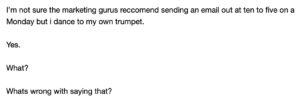
An email written by a human man
Can I help you sound like you?
It might feel a bit weird to think of – not to mention trust – someone else writing as you. But that’s exactly what I do for many of my clients.
(Just think of me as a copy-chameleon).
In another ‘classifier’-type test, one of my clients recently challenged his clients to see if they could tell which of his blog posts had been written by him, and which ones by me.
They couldn’t.
If I do say so myself, I’m both a good writer and an excellent listener. I’ll not only take note of how you express yourself, but I’ll also home in on the story you want to tell.
Then I’ll tell it, in human-written words that sound like you.
If you like, you can find out more about my client work, or schedule a free, no-obligation chat about how we might write together.
*I’m proud to say that my own web copy and blog posts were classified as ‘human-written’. Result.