
The Despair of the Copywriter in the Age of AI
05 June 2026
The title of this piece is borrowed from a recent article in The New Yorker, in which a handful of American college professors talk about how AI has changed their work. It’s worth a read, even if only to ponder those professors’ stories and then ask yourself: if I were a student again, and I had access to AI, would I use it to cheat?
I can’t say for certain that I wouldn’t. As a teenager, I didn’t understand how important it is to think independently for myself. Or that I’d only learn how to think independently for myself by articulating my thoughts and opinions, in my own voice.
Even if I had understood all that, I doubt I’d have cared enough to resist the temptation of having a machine think and articulate for me, back then. I’d avoid all the mental mess that way, and I’d also spare myself the potential embarrassment of getting it wrong. As anyone who has ever been a teenager knows, avoiding that kind of embarrassment is vital.
I’m an adult now, though.
In my work as a copywriter and ghostwriter, I write ‘as’ different people. What’s important about that is understanding the way each one of them naturally thinks and speaks, so I can convey those nuances in words. My ultimate aim is for readers – especially ones who already know those people well – to think they wrote that copy, or that book, themselves.
(Think about reading five different samples of writing, only one of which is written in the ‘voice’ of your best friend. You would pinpoint it immediately).
In recent years, a handful of my clients have upped sticks to AI. ‘Their’ writing is still informative and correct, but it no longer sounds like them. On the page, everyone is starting to sound the same. I can’t help feeling sad and frustrated about that; not just as a writer, but as a reader.
If I’m reading a piece of writing by someone I know, I want to hear them in it. If I’m reading a piece of writing by someone I don’t know, I want to hear something that tells me who they are.
That’s not much to ask, is it?
When I work with a new business client, I’ll often send them a briefing questionnaire. The questions aren’t just practical (who is your audience?). They’re also designed to make that client think about what they want to say, and how they’d like to say it (how would you explain what you do to a new customer?).
I’ve noticed that many of these clients now pass my questions to AI chatbots, which give long, drawn-out, often useless answers that sound like nobody in particular. One of my questions – what are the three most common questions new customers ask about your product or service? – is answered with the three questions only, since I don’t explicitly say that I also need the answers, and AI chatbots respond literally.
(Clients who respond to my questionnaire themselves offer the questions and their answers, of course).
The upshot is, I now have to ask my briefing questions in person and record the answers myself, which takes more time and more work. Clients don’t expect to be charged for that, which can cause resentment before I’ve written a single word for them.
On the ghostwriting side, some clients will insist on writing everything with AI, for me to then edit “in my voice”.
Many believe it’ll be cheaper that way. It isn’t, though, because editing out blandness is harder than writing a first draft with natural personality. It’s harder still when I haven’t had enough conversations with that client to know what “my voice” sounds like.
We’re all supposed to shrug and murmur things like, “AI is here to stay, so we have to accept it.” But I don’t; at least, not when it comes to writing. Or thinking. And writing is thinking.
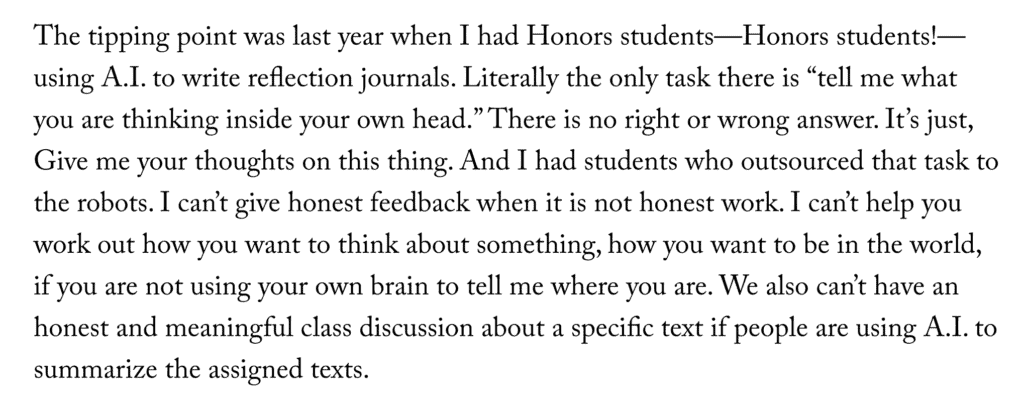
An excerpt from The New Yorker’s article: The Despair of the Professor in the Age of A.I., as linked above.
The professors in The New Yorker’s article talk about the despair they feel, that so many essential facets of learning – and of understanding who you are – have been so easily passed over. (They’re surprised, as well: why wouldn’t their students want to learn and grow?). Then they talk hopefully about the barriers they’ve put in place, like in-person lessons only, or asking for handwritten essays.
But at the end of the day, we all have to want to not use AI to think for us. We have to see the value in our own humanness, and in the skills we work hard to hone. We have to see the value in doing the work.
Ten years ago, I set myself up as a freelance writer. I wouldn’t advise anyone to do that now, even if they were the best writer in the world. I wouldn’t do that now.
I’m seriously thinking about not writing for others anymore. Too many of them seem to resent the time and effort I spend on the work, and why bother, when AI can do a passable enough job for less?
(But it’s the “why bother” part that matters most, isn’t it?).