
Three Web Copy Mistakes Lots of Companies Make
31 May 2023
Agh. I hate blog-lists of things like “three common web copy mistakes”, “five tips to elevate your socks”, and “seven ways to achieve greatness with lettuce”.
(They’re always odd numbers, aren’t they?)
But since I really have identified three common web copy mistakes, I hope you’ll bear with me. Especially since I write web copy for a living; something I feel gives me a tiny bit of authority on the subject.
So, let’s begin with Mistake Number One: following the age-old royal motto of “never complain, never explain” far too closely.
First, tell us who you are
Part of my job as a writer-for-hire also involves crafting CVs. In these, I add links to the companies the CV-ee worked for, alongside a short description of what each company does.
You might think this is an easy task. It isn’t always, because many companies don’t use their websites to explain what they do. At least, not straight away.
Instead, I have to scroll through endless statements that start with things like: “At CompanyX, we believe in putting our customers first”, “Let us explain our ‘why’, or “Here’s an excruciatingly long list of our values”.
If I’m lucky, somewhere towards the end the website might mention that this company makes widgets for whirlybirds. But by then I’ve just about lost the will to live. Had I been a casual browser, I would have given up altogether.
It’s great that you’re so interested in your customers, or you want to tell us about your life’s ultimate purpose. But please, explain what it is you actually do first.
The same goes for explaining industry jargon and acronyms that make perfect sense to you, but could befuddle casual browsers. Even if you think you’re writing for people who already ‘get it’, you never know who might be reading, or what your words might inspire them to do.
Second, make the reading experience flow like an easy river
Some companies make reading their web copy feel like prep for a dreaded exam.
For example: I was on the radio last week (get me!) talking about the UK’s least-favourite slang words. The show’s producer asked me if I’d like to be introduced as a language coach. I said no; mostly because I’m not a language coach.
Or was I? I realised that I didn’t know much about what a language coach is or does, so I looked it up.
“A language coach uses an applied methodology incorporating coaching fundamentals into the language coaching context,” said one language-coaching website.
Right.
What was that, again?
Reading your website shouldn’t be a chore, it should be a pleasure. Which leads me nicely onto…
Third, ditch the tired search-engine-ese
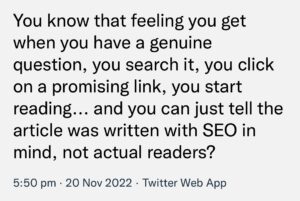
I didn’t write this Tweet. But I do know “that feeling” well. I expect you do, too.
Nailing the behind-the-scenes fundamentals of SEO is enough.
Take it from me, whose website is currently listed on Page One of Google for ‘copywriter Essex’ and ‘ghostwriter Essex’.
I don’t do complicated keyword research or long-winded SEO analysis, I just blog regularly. This feeds my website with fresh new words; many of which people naturally use to look up writing services like mine.
Blogging regularly also offers a reason for people to keep coming back to my website, even if only because they don’t like me.
(I often visit the websites of people and businesses I don’t like. Criticising them in my head is a fun way to spend a few spare moments).
Don’t think AI will save you, by the way. ChatGPT might be able to write clear copy, but most of it will be boring and personality-free because AI doesn’t write – or read – for the love of it. Remember: good copy isn’t just about attracting people to your website, but encouraging them to want to work with you once they’re there.
Engaging words that read like you at your warmest, chattiest, most informative best, will do a very good job of achieving that.
Can I help you write for your website?
Whether you’re launching something new or relaunching something old, I’d love to be of assistance.
Email me or book a friendly chat to talk about how, together, we might weave web copy magic.