
Coming Soon, to a Business Near You: Attack of the Costly SEO Consultants!
23 November 2022
The one sentence that’s guaranteed to shrivel my writer’s soul is: “We’ve recently been working with an SEO consultant.”
When a client utters these terrifying words, I assume the brace position. There’s a tsunami frothing on the horizon, made of lengthy, over-complicated reports and inane lists of “extensively-researched keywords”. Not to mention the systematic dismantling of my carefully-written words.
If that sounds like sour grapes, it sort-of is. I’m a creative writer, not a statistician.
But it’s also because I’ve witnessed the work of many an overpriced SEO consultant during my career as a professional writer. And as Shania Twain once sort-of sang, they don’t impress me much.
What follows are anecdotal examples
I’m not saying every SEO consultant does expensive work that’s silly and pointless.
These are just examples of my – separate – dealings with those who do.
Example One: I received a spreadsheet consisting of over 50 “individually-researched keywords”. I was asked to insert each keyword a set number of times into the briefed client article – which itself was only supposed to be 1,500-words long.
Example Two: I got an invitation to an hour-long meeting, to discuss “SEO-positioning” for one 300-word article.
Example Three: The consultant sent me a 30-page briefing report on how to SEO-write for a particular client. It was full of ideas and guidance I had already suggested to that client under separate email cover, copied and pasted word-for-word.
Example Four: Some client-approved copy, which I’d written on the basis of appealing to actual people, was mauled like the sorry carcass of an antelope in the savanna. This was due to the overwhelmingly heavy-handed addition of “identified search terms” throughout.
(“Do you want this for your writing portfolio?” the client kindly asked me later. That was a polite no.)
Example Five: A writing project was put on hold for weeks, while the client’s SEO consultant carried out their “extensive topic research”. When I finally received their report, it included precisely one “key topic” that my ailing Nan could easily have plucked from the top of her head.
I wouldn’t have minded any of these examples occurring, if what they were trying to achieve was actually proven to be effective.
Or if any of them contained genuine expertise that writers like me could respect and learn from.
Too much SEO-ing alienates people looking for real human connection
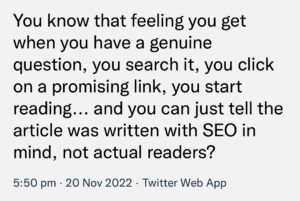
I didn’t write this Tweet. But I do know “that feeling” well. I expect you do, too.
I doubt I’m the only person who never clicks on the top result in a Google search. If I do, I’ll hit a wall of search-engine-ese, and I’m not interested in the blandishments of words written for a robot army.
Mostly, I hate that writing has become something people do for clicks, Likes, and “increased user engagement”, rather than because they enjoy it. The results of this approach have landed us with an online world stuffed with people saying exactly the same things, in exactly the same boring ways.
That “100+ point on page/off page review” of your website isn’t going to tell you how to talk to real people, and nor can it predict how real people will respond.
But as it’s real people we’re all trying to reach, why don’t we try harder to connect with them: one human to another? We could start by caring just a little bit less about what the search-engines think.
Looking on the bright side?
None of this is to say that I don’t believe SEO is at all helpful.
I trained in SEO-writing at the start of my career, and its basic principles have helped me subtly improve the words I write for my clients, as well as myself.
I frequently do my own, common-sense-based, keyword and competitor research, based on advice from Google Essentials. You can do this too; it doesn’t take long, and you’ll come away with some useful insights.
Meanwhile, when you write about your business, you will naturally incorporate keywords and search terms that people might use. Write regularly, and you’ll fill your site up with them. That means you won’t have to play Keyword Jenga with each individual blog post.
I get good Google search-results because I work with a clued-up web design and development team who know how to optimise my site, and because I update my blog at least twice a month, using words I actually say.
That’s it.
If you want to work with an SEO consultant on the more detailed technical aspects, Google also has some good advice about how to choose the right one. This includes useful questions that will help you get to the heart of your consultant’s expertise.
(Here’s one tip for you: don’t believe anyone who says they’re “Google-certified” for SEO. This certification doesn’t exist, though worryingly I’ve seen it pop up on a few websites.)
I wish you the best of luck!